Karmil Streams
Institute-Level Research Framework for Phase-Oriented Continuity Science
Phase Theory · Stream Architecture · Coherence Diagnostics · Analytical Infrastructure
Research Overview
Karmil Streams is an interdisciplinary research framework dedicated to the study of continuous dynamic systems through phase coherence, structural continuity, and hierarchical stream architecture.
The framework proposes that:
- phase coherence is a primary structural regulator of stability
- continuity is an invariant prior to decomposition
- complex systems behave as embedded multi-scale streams
- instability originates from phase divergence rather than amplitude collapse alone
This platform integrates theoretical formalization, analytical infrastructure, and cross-domain scientific diagnostics within a unified phase-oriented architecture.
Institutional Research Orientation
Karmil Streams is positioned as an evolving scientific program operating at the intersection of:
- Continuity Theory
- Phase Systems Science
- Structural Dynamics
- Complex Systems Analysis
- Coherence Diagnostics
The objective is not the replacement of existing paradigms, but the introduction of a phase-structural layer of analysis applicable across disciplines.
Analytical Infrastructure: Stream Analyzer
The framework includes a dedicated analytical environment designed for phase-based diagnostics of continuous systems.
Core Modules
Pilot Analyzer — real-time analysis Corpus Analyzer — dataset analysis Regime Detection Engine — regime detection A/B — comparative diagnostics Analysis — system overview
Functional Capabilities
- detection of coherence ruptures
- phase misalignment tracking
- regime transition identification
- multi-scale stream diagnostics
Development trajectory:
Prototype → Scientific Diagnostic Engine → Corpus-Based Research Platform
Abstract
Karmil Streams is a developing phase-structural paradigm dedicated to the analysis of continuous dynamic systems. In contrast to spectral, statistical, and chaos-based frameworks, the theory proposes that structural stability, transformation, and systemic resilience are governed primarily by phase coherence rather than by amplitude magnitude, energy accumulation, or probabilistic distribution alone.
Continuity is treated as a structural invariant organized through phase topology. Systems are interpreted as hierarchically embedded streams governed by coherence gradients across multiple scales.
The paradigm remains in structured formation and ongoing mathematical refinement.
1. Historical Genesis and Theoretical Emergence
Modern scientific frameworks provide powerful analytical instruments:
- Fourier spectral decomposition
- probabilistic inference
- nonlinear dynamical modeling
- attractor and chaos analysis
- statistical signal processing
However, a recurring structural limitation persists:
Continuity becomes fragmented under reductionist decomposition.
Many dominant paradigms reconstruct continuity from discrete fragments.
Karmil Streams begins from the opposite methodological direction:
Continuity must be structurally preserved prior to decomposition.
Development trajectory:
- Conceptual phase ontology
- Formalization of phase tendencies
- Structural Parameter System (SPS) architecture
- Stream Analyzer infrastructure
- Comparative corpus experimentation
2. Ontology of Stream
Reality is interpreted not as isolated entities but as structured continuities — Streams.
A Stream is defined as organized continuity characterized by:
- internal phase topology
- coherence gradients
- hierarchical embedding
- structural tension dynamics
Ontological Shift
| Classical Ontology | Stream Ontology |
|---|---|
| Object | Continuity |
| Event | Dynamic Stream |
| Static State | Phase Structure |
| Discrete Model | Structured Continuum |
Structural identity emerges from sustained phase alignment across embedded layers of continuity.
3. Phase as Primary Structural Principle
In conventional analytical systems, phase is secondary to amplitude, energy, or probability distributions.
Within Karmil Streams:
Phase is ontologically and structurally primary.
Stability ≠ maximal energy
Stability = sustained phase coherence
Phase encodes:
- synchrony
- relational positioning
- structural tension
- coherence depth
Systemic instability begins with phase divergence before energetic or statistical collapse becomes observable.
4. Core Phase Tendencies
The framework identifies directional phase-structural tendencies within continuous systems:
- downphase — centripetal concentration of structural coherence
- outphase — centrifugal expansion of phase distribution
- rephase — restoration of systemic coherence
- diphase — structural divergence within embedded streams
- megaphase — multi-layer equilibrium across hierarchical scales
These tendencies represent a partial taxonomy of the broader phase-field architecture and remain under formal classification development.
5. Structural Parameter System (SPS)
The Structural Parameter System defines the measurable geometry of phase-organized continuity.
Core Parameters
- d_φ — disphase (phase misalignment metric within the Stream)
- E_str — structural stream energy
- D_str — global disfusion state of the Stream
- L_str — extended layer tension across embedded structures
- V_sw — vortical and funnel structural motion formation
- K_eq — equilibrium coefficient of the Stream
- F_ext — external force acting upon the Stream
These parameters form the basis for phase-field diagnostics and structural stability analysis.
6. Mathematical Orientation
6.1 Stream Representation
6.2 Stability Functional
6.3 Coherence Functional
6.4 Structural Energy Evolution
6.5 Instability Condition
These formulations represent structural approximations within an ongoing process of mathematical formalization and validation.
7. Unified System of Streams (USS)
Multiplex Stream = Megastream.
No Stream exists in isolation.
Each Stream is hierarchically embedded within higher-order Streams.
Foundational Principles
- hierarchical embedding
- scale coherence
- cross-stream correlation
- structural universality
The USS model proposes coherence as a cross-domain invariant applicable to physical, biological, cognitive, and socio-dynamic systems.
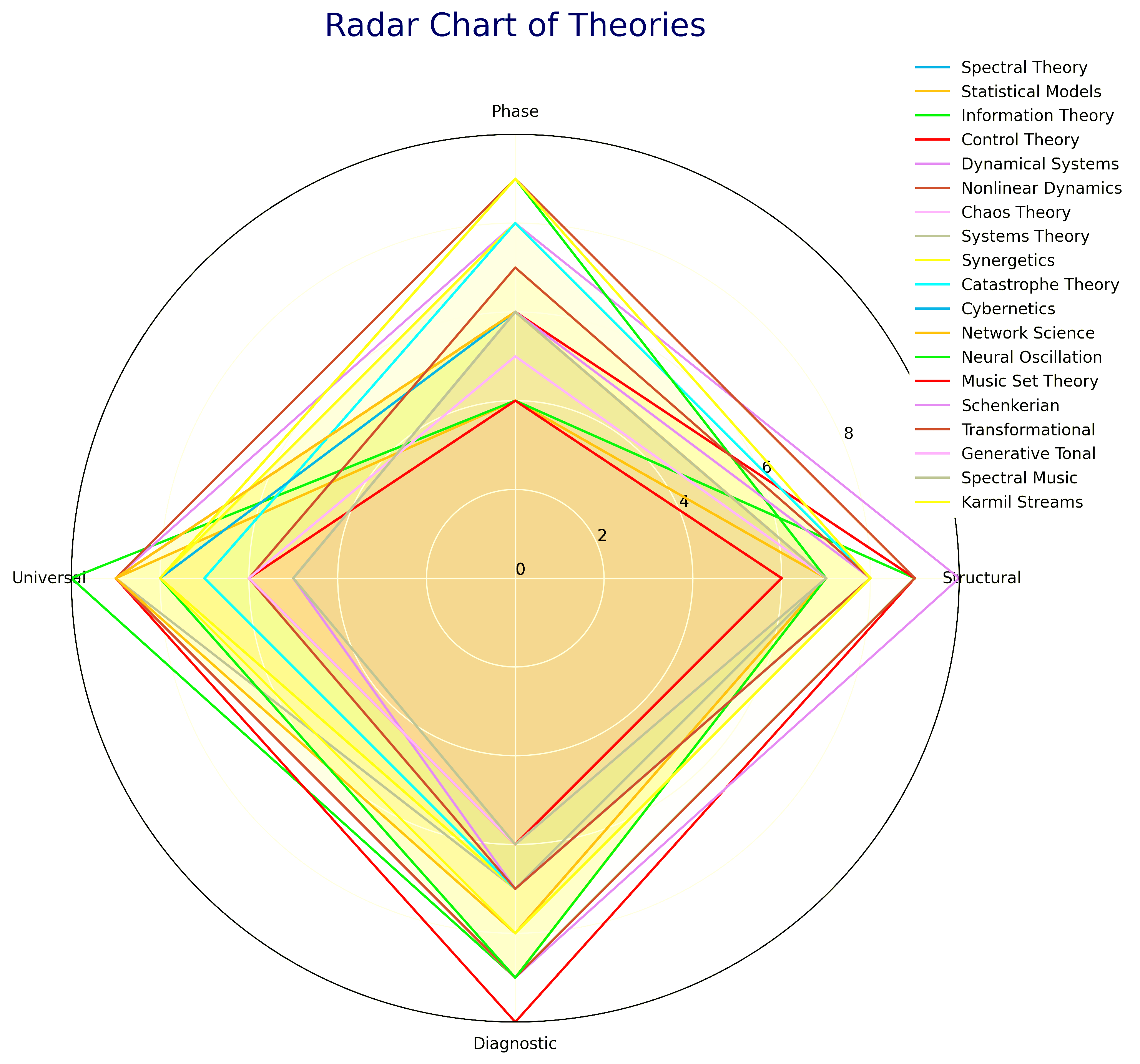
8. Comparative Scientific Positioning
Scale (0–10)
0–3: limited phase-structural scope
4–6: moderate domain specificity
7–8: strong in-domain structural relevance
9–10: cross-domain structural robustness
| Theory | Author | Structural | Phase | Universal | Diagnostic |
|---|---|---|---|---|---|
| Spectral Theory | Fourier | 9 | 6 | 9 | 9 |
| Information Theory | Shannon | 9 | 4 | 10 | 9 |
| Dynamical Systems | Poincaré | 10 | 8 | 9 | 9 |
| Nonlinear Dynamics | Strogatz | 9 | 9 | 9 | 9 |
| Synergetics | Haken | 8 | 8 | 8 | 7 |
| Systems Theory | von Bertalanffy | 7 | 6 | 9 | 7 |
| Neural Oscillation | Freeman | 7 | 9 | 8 | 9 |
| Music Set Theory | Forte | 6 | 4 | 6 | 6 |
| Transformational Theory | Lewin | 8 | 7 | 6 | 7 |
| Karmil Streams | Karmil | 8 | 9 | 8 | 8 |
9. Interdisciplinary Research Applications
Medicine
- cardiac coherence diagnostics
- neural oscillation phase mapping
- systemic resilience modeling
Physics
- turbulence phase topology
- wave interference coherence analysis
- non-equilibrium regime diagnostics
Mathematics
- phase-invariant topology
- coherence functional theory
- multi-scale embedding systems
Psychology and Cognitive Science
- cognitive regime transition modeling
- coherence disruption and restoration analysis
Astrophysics
- cyclic stellar dynamics
- multi-periodic coherence structures
Social Systems
- macro-synchronization detection
- crisis-phase modeling in complex societies
10. Development Status
Established Foundations
- phase ontology
- SPS parameter architecture
- analytical infrastructure (Stream Analyzer)
Ongoing Scientific Work
- formal mathematical rigor
- algorithmic validation
- empirical corpus expansion
- interdisciplinary peer evaluation
The framework remains in a stage of structured scientific development rather than a finalized closed theory.
Institutional Declaration
Karmil Streams is presented as an open, evolving research program dedicated to the formal study of phase-organized continuity across complex systems.
The Unified System of Streams (USS) is proposed as a long-term scientific architecture subject to:
- mathematical formalization
- empirical validation
- interdisciplinary academic review
Publication Information
Title:
Karmil Streams — A Phase-Oriented Paradigm of Continuous Systems
Author:
Ferhat Karmil — Independent Researcher
Research Domain:
Continuity Science · Phase Systems · Structural Dynamics · Coherence Diagnostics
Institutional Status:
Independent Research Initiative
Project Period:
2025–2026 (Ongoing Scientific Development)
Correspondence:
https://www.karmils.com
© 2026 Karmil Streams
All rights reserved.